
Friday, October 16, 2015
We're Switching to TSU

Saturday, October 10, 2015
I will be eaten?

This restaurant banner reads, "no matter what you imagine, you will be eaten more than you expect." The problem is that the phrase "you will be eaten" has two possible meanings, and the restaurant does not mean either one.
One meaning is the dictionary meaning of "to eat." You will go to this restaurant and, instead of you eating the food, someone or something will eat you. This implies that you would lose limbs (fingers, hands, arms, toes, feet, legs), ears, or noses, and possibly even die. So we really don't think this restaurant is advertising that.
A second meaning is sexual, and we will not explain that here. But this meaning suggests that women who go to this restaurant will have a specific sexual act performed on them. Again, we really don't think this restaurant is advertising that.
There are two correct ways to say this instead. First, you could say "you will eat more than you expect." Or, you could say, "you will be eating more than you expect." In the English language, these very small changes make the difference between suggesting that you will eat food or suggesting that you will endure violent or sexual acts.
Tuesday, September 29, 2015
One step ahead

The phrase "one step ahead" does not make sense when it is out of context. After all, what exactly is one step ahead? Danger?
Because this sign was above a bathroom urinal, we could figure out the meaning. Someone, probably a janitor, wants men to stand one step closer to the urinal so as to reduce messiness.
A better way of stating this, however, would be, "take one step forward."
Tuesday, September 22, 2015
Traditional Coffee Blood

We have never heard of "coffee blood" before, so we think this is meant to say "coffee blend." That certainly makes more sense, anyway.
This napkin has a few other minor issues, as well: 1) the company name should consistently be "Hands Coffee," with a space and proper capitalization, 2) the word "traditional" should have a lowercase "T," and 3) the slogan "My belief. My choice." sounds like a controversial American political subject.
Without knowing exactly what this coffee shop intended, a better way of writing this could be: "Hands Coffee (traditional coffee blends of southern French style) loves specialty hand drip coffee and authentic European espresso."
Saturday, September 5, 2015
Pull door open for... what?
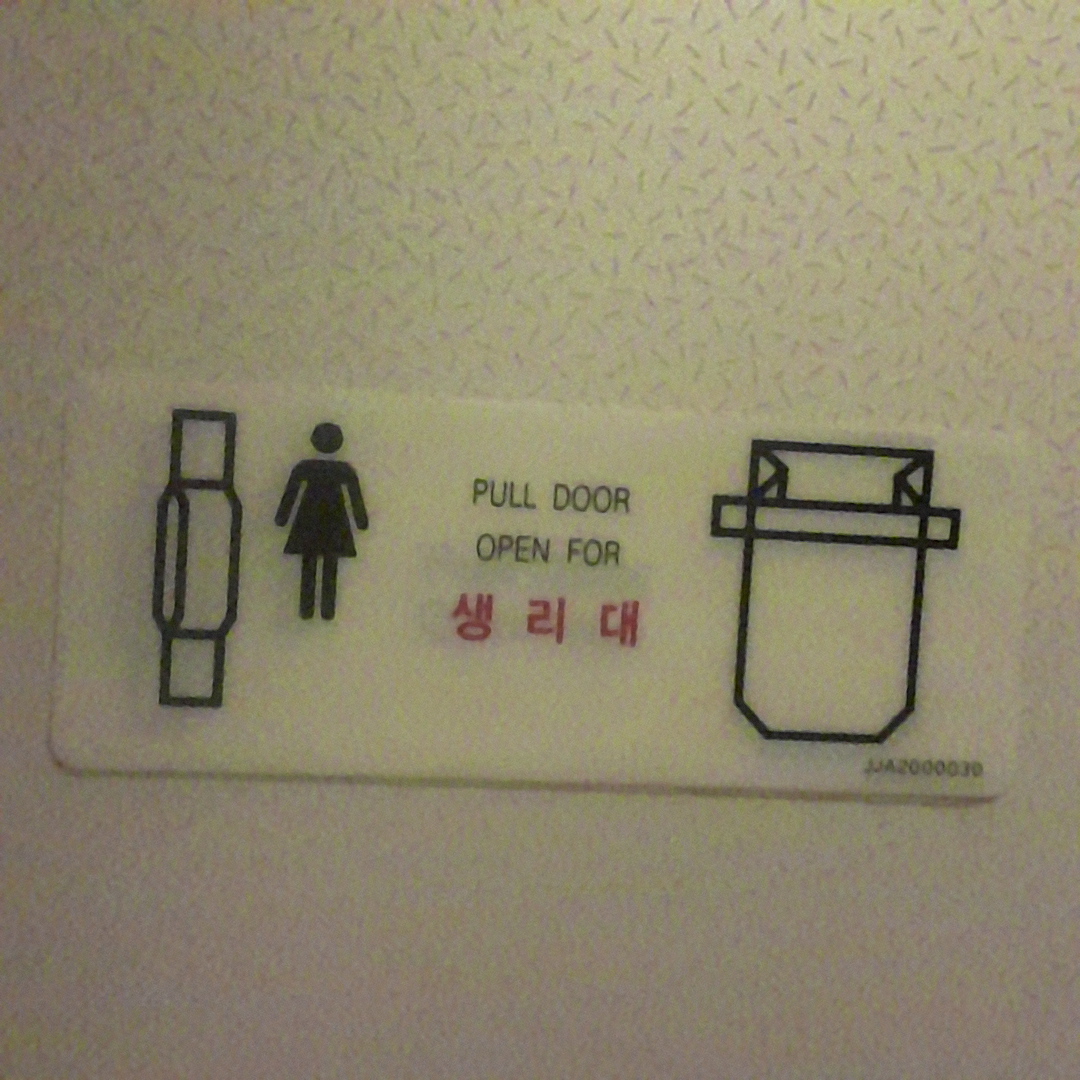
We found this sign in an airplane bathroom. The problem is that if you only understand Korean, you may know that you want to open this door, but you may have to figure out how; do you push it in, pull it out, slide it aside, or what? And if you only understand English, then you may know how to open this door without actually knowing what you could pull this door open for. Or, maybe you shouldn't open it all.
For English speakers, the size and shape of the door looks like a diaper changing table. But, it isn't. Plus, the sign only shows an image of a woman, not a mother or father with a baby. The Korean translates to "sanitary napkins."
As we have recommended before, it would be better to have two complete translations: one in Korean and one in English.
Sunday, August 23, 2015
That's offensive.

Disclaimer: we censored this photo.
This is a vending machine on a street in Wonju, Gangwon Province, South Korea. We recommend that tourists always stop and take a look, because these vending machines usually have peculiar items in them. For example, we've seen lingerie for sale in one of these. And, again, these are not indoors, but on the street where children walk by.
This particular vending machine caught our attention because of the belt buckle at the bottom. Most Koreans probably don't understand the meaning and probably don't know that this phrase is offensive. On the other hand, profanity in Korea, at least by Koreans, seems more acceptable in more locations, in front of children, and even from children.
Also, this belt buckle is not unique. It is not uncommon to see Koreans out in public wearing hats and shirts with English profanity. Again, this could be a mix of misunderstanding and greater acceptance, but some of it is offensive. Much of it is meaningless, due to mistranslations, but sometimes you'll find something more like this belt buckle.
Tuesday, August 11, 2015
May I have you?

This is from an English workbook for young Korean learners. Because the waiter in this illustration is speaking to two people at a table, "may I help you" is the correct choice. The other choice, "may I have you," is a request for sexual intercourse. As you can see, the elementary school student first picked the inappropriate second choice, which is why that second option does not belong in this book. The writers and publishers really should have thought of something else.
Sunday, July 26, 2015
My robot is good teacher?

This is the cover of a notebook. Sadly, this is one of many, many notebook styles in Korea that is used by English students even though the English expressions on the front and back covers always have errors.
Koreans often omit the articles "a," "an," or "the," because these articles do not exist in the Korean language. However, the English language requires them. Therefore, the sentence "my robot is good friend" should be "my robot is a good friend" and the sentence "my robot is good teacher" should be "my robot is a good teacher."
Sunday, July 12, 2015
Show the "ghetto power?"

"The four elements of the street culture together always will show the ghetto power" should instead be written "together, the four elements of the street culture will always show the ghetto power." Sadly, other than being correct English, this still doesn't make any sense. What are the four elements of street culture? What is ghetto power? We don't know.
Saturday, June 27, 2015
A skank eats cheese?

There can be a big difference between using the letter "a" and the letter "u", or, in this case, a letter "u" that looks too much like a letter "a." A "skunk," which this word is supposed to be, is an animal. A "skank," which this word is not supposed to be, in an insult that one person might call another.
Thursday, June 18, 2015
Visit to a... what?!?!?

This is an actual medical bill for visiting a doctor. Unfortunately, the doctor's first initial is "A" and his family name is "Dick," and calling someone "a dick" is an insult.
If only someone had reviewed this, the best alternative would probably be to use his full first name, instead of the initial "A," plus the prefix "Dr." A visit to "Dr. Alfred Dick" or "Dr. Abraham Dick" or "Dr. Alex Dick," or whatever his name is, would be highly preferable to just "Visit to A Dick."
Monday, June 8, 2015
We never sicken with love twice.

"Love sick" is an English idiom, but it is used as a state of being, not as a process. Someone can be love sick, in which case he or she loves someone else very much, but someone does not "become sick" or "sicken" with love. A better way of writing this would be: "No, we are never stricken with love twice."
The second sentence, "Cupid spends no second arrow on the same heart," sounds very nice and is rather poetic.
A third sentence, above these, simply needs punctuation and one letter capitalized: "If you would be loved, love and be lovable."
Wednesday, June 3, 2015
Enjoy a... ddung burger???

In English, "dung" means feces, or the solid waste that leaves your body through your anus. Adding another letter D does not change the sound, and naming food after it is a very bad idea.
Monday, June 1, 2015
Wonju Bus Terminal

Photographed on an inside wall at the bus terminal in Wonju (원주시), Gangwon Province (강원도), South Korea (대한민국), this has no meaning in English. Because Wonju begins with the letter "W," someone decided to nickname the city "W-city" and then list a few random English words that also begin with the letter "W." The use of "so" suggests that these words are a reason to use Wonju bus terminal, yet these words do not form a complete sentence, do not describe Wonju city, and do not describe bus travel.
A better way to write this would be to forget about the "W" theme, forget about listing unrelated words, and just write a normal English sentence.
Friday, May 29, 2015
Services and mental?

To be honest, without a translation of the Korean language we have no idea what "services and mental" is supposed to mean, nor can we recommend a better way of stating this message in English. This would seem to have something to do with providing customer service, but we don't know in what way.
This is another example where either a second, full English translation should be provided for English speakers who probably can't read the Korean at all, or the entire message should be only in Korean since not every Korean understands English.
Sunday, May 24, 2015
This is from an English teacher?!?!?


This is from an English teacher? Besides poor punctuation, "a easy decision" should be "an easy decision."
A second image, intentionally not included due to branding, states "one dogs - My friend has a dogs." First of all, you can't have "one dogs," you can only have "one dog." "Dogs" is plural, meaning more than one. Also, either "my friend has a dog" or "my friend has dogs," but no one can have "a dogs."
The moral of this post is to be careful who you learn from.
Wednesday, May 20, 2015
Get a smart body.

Photographed at a fitness center in Andong (안동시), North Gyeongsang Province (경상북도), South Korea (대한민국), we first thought that this meant to say, "get smart, baby." Calling someone "baby" can indicate endearment or affection and is different from calling someone "a baby," which insultingly compares them to a newborn child.
However, because the adjacent sign reads, "make the best body," the first sign probably meant to say, "get a smart body."

Thursday, May 14, 2015
Writing a Better Warning Label

Keeping the same sentence structure, you could rewrite this as:
WARNING: If the rotor blade is damaged, do not fly it; it will result in fuselage damage.
However, a better way to rewrite this would be:
WARNING: Operating with rotor blade damage could result in fuselage damage.

Friday, May 8, 2015
Grand Open

Photographed in Andong (안동시), North Gyeongsang Province (경상북도), South Korea (대한민국), the use of "Grand Open" is common throughout the Republic of Korea. However, the phrase should be "Grand Opening."
Actually, the English should be removed from this sign. If you don't read Korean, then you don't know what kind of business is opening here unless you look through the windows. And if you read Korean, then you may not be able to read the English. The best approach, if there will be English-speaking employees, would be to have one sign fully in Korean and another fully in English. If not, just keep the signs fully in Korean.
Thursday, April 30, 2015
The natural love for coffee

Photographed outside a coffee shop somewhere in South Korea (대한민국), this contains two statements. The phrase "the natural love for coffee" is not a sentence, but it works as a slogan. The sentence with it, however, would read much better as "you can taste the love."
Subscribe to:
Posts (Atom)