Tuesday, September 29, 2015

One step ahead

one step ahead, one step forward, one step, urinal, bathroom, restroom, washroom, latrine, lavatory

The phrase "one step ahead" does not make sense when it is out of context. After all, what exactly is one step ahead? Danger?

Because this sign was above a bathroom urinal, we could figure out the meaning. Someone, probably a janitor, wants men to stand one step closer to the urinal so as to reduce messiness.

A better way of stating this, however, would be, "take one step forward."

Tuesday, September 22, 2015

Traditional Coffee Blood

traditional coffee blend, coffee, coffees

We have never heard of "coffee blood" before, so we think this is meant to say "coffee blend." That certainly makes more sense, anyway.

This napkin has a few other minor issues, as well: 1) the company name should consistently be "Hands Coffee," with a space and proper capitalization, 2) the word "traditional" should have a lowercase "T," and 3) the slogan "My belief. My choice." sounds like a controversial American political subject.

Without knowing exactly what this coffee shop intended, a better way of writing this could be: "Hands Coffee (traditional coffee blends of southern French style) loves specialty hand drip coffee and authentic European espresso."

Saturday, September 5, 2015

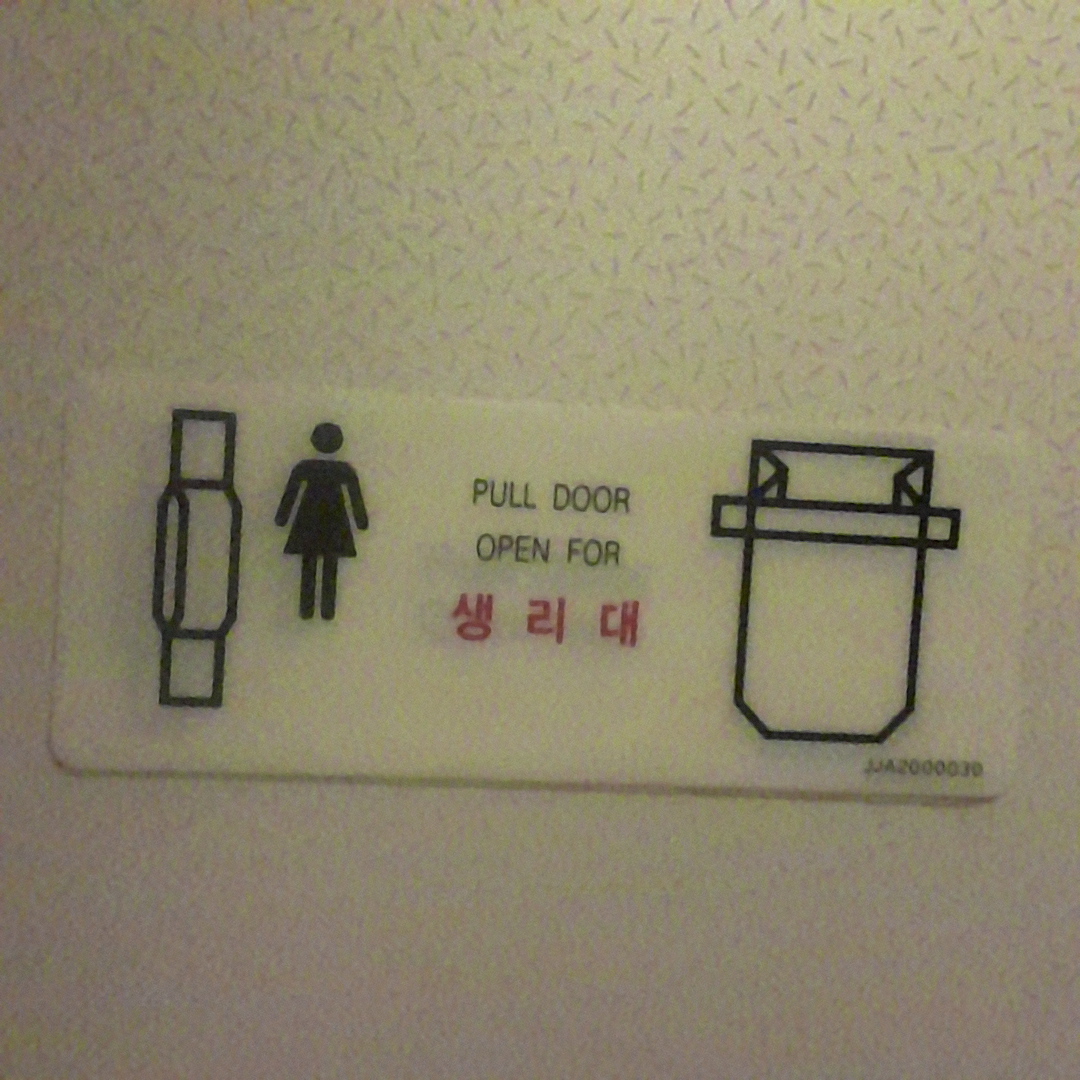
Pull door open for... what?

English, bathroom, bathrooms, restroom, restrooms, washroom, washrooms, lavatory, lavatories, latrine, latrines, sign, signs, signage

We found this sign in an airplane bathroom. The problem is that if you only understand Korean, you may know that you want to open this door, but you may have to figure out how; do you push it in, pull it out, slide it aside, or what? And if you only understand English, then you may know how to open this door without actually knowing what you could pull this door open for. Or, maybe you shouldn't open it all.

For English speakers, the size and shape of the door looks like a diaper changing table. But, it isn't. Plus, the sign only shows an image of a woman, not a mother or father with a baby. The Korean translates to "sanitary napkins."

As we have recommended before, it would be better to have two complete translations: one in Korean and one in English.

Sunday, August 23, 2015

That's offensive.

offend, offends, offending, offensive, profane, profanity, vulgar

Disclaimer: we censored this photo.

This is a vending machine on a street in Wonju, Gangwon Province, South Korea. We recommend that tourists always stop and take a look, because these vending machines usually have peculiar items in them. For example, we've seen lingerie for sale in one of these. And, again, these are not indoors, but on the street where children walk by.

This particular vending machine caught our attention because of the belt buckle at the bottom. Most Koreans probably don't understand the meaning and probably don't know that this phrase is offensive. On the other hand, profanity in Korea, at least by Koreans, seems more acceptable in more locations, in front of children, and even from children.

Also, this belt buckle is not unique. It is not uncommon to see Koreans out in public wearing hats and shirts with English profanity. Again, this could be a mix of misunderstanding and greater acceptance, but some of it is offensive. Much of it is meaningless, due to mistranslations, but sometimes you'll find something more like this belt buckle.

Tuesday, August 11, 2015

May I have you?

help, English, inappropriate, improper, unseemly, unsuitable, unfitting

This is from an English workbook for young Korean learners. Because the waiter in this illustration is speaking to two people at a table, "may I help you" is the correct choice. The other choice, "may I have you," is a request for sexual intercourse. As you can see, the elementary school student first picked the inappropriate second choice, which is why that second option does not belong in this book. The writers and publishers really should have thought of something else.

Sunday, July 26, 2015

My robot is good teacher?

English, notebook, robot, robots, android, androids, droid, droids, bot, bots, teacher, teachers, teaching, teaches, instructor, instructors, instructs, professor, professors, lecturer, lecturers, educator, educators, educate, educates

This is the cover of a notebook. Sadly, this is one of many, many notebook styles in Korea that is used by English students even though the English expressions on the front and back covers always have errors.

Koreans often omit the articles "a," "an," or "the," because these articles do not exist in the Korean language. However, the English language requires them. Therefore, the sentence "my robot is good friend" should be "my robot is a good friend" and the sentence "my robot is good teacher" should be "my robot is a good teacher."

Sunday, July 12, 2015

Show the "ghetto power?"

four elements, street culture, ghetto power

"The four elements of the street culture together always will show the ghetto power" should instead be written "together, the four elements of the street culture will always show the ghetto power." Sadly, other than being correct English, this still doesn't make any sense. What are the four elements of street culture? What is ghetto power? We don't know.